The post Video Games…and Cryptocurrency? An Analysis appeared first on CBNN NEWS.
]]>Video Games…and Cryptocurrency? An Analysis
If you’re like me, a complete video game nerd to the core, you probably had an advantage fundamentally understanding cryptocurrency when it was first widely introduced. For years, gaming studios and publishers all over the world were introducing their own in game digital currency, which could only be bought by trading in your fiat. Does that sound familiar? You could then use the currency in-game, whether it be for costumes or slight opponent advantage.
Then came the loot boxes, a much more randomized system where a player will purchase in-game currency → buy a loot box with random items → pray they landed a much more expensive item for half the price. I will leave the issues with loot boxes to regulators, since many state it greatly resembles gambling.
This in-game currency system for opponent advantage or social status has become the core business model for publishers, rather than the actual game itself.

Let’s use the crazy popular last man standing game “Fortnite” as an example. They use a free to play model. In this model, the game itself is completely free to download and enter. However, if you want the premium content and offers, get ready to shell out $5 minimum. For even better content, expect to be spending monthly. This goes against the old models for revenue, where you payed $60 for the complete game and that was it. At face value, it may seem like the publisher is sacrificing revenue to generate player activity, but that is not the case. “Fortnite now has 45 million players and over 3 million concurrent users” [1] Lets break this down.
Forget the 45 million players, because games only incur revenue with active play. Now, lets assume only 1.6 million concurrent players out of 3 million purchase V-Bucks (their in game currency)
1 million players spend $10 dollars a year in V-Bucks = $10,000,000.00
500,000 players spend $15 dollars a year in V-Bucks = $7,500,000.00
100,000 players spend $30 dollars a year in V-Bucks = $3,000,000.00
That’s $20,500,000.00 in yearly revenue from ONLY HALF their free to play user base of concurrent players. The other half of purely free users can bring in revenue from word of mouth and streaming on platforms such as Twitch. We can probably assume this is a low ball estimate in revenue. Please note that these are speculative numbers and the dollars spent per player is not open data; but the numbers I’ve chosen are reasonable for a typical gamer.
This is much more profitable then the $60 per game model. Free players may think they are playing at a discount, but many are spending far more at the end of the year! If you spend $10 a month (which players tend to do) on in game (rather than $60) than you can expect to pay double for the same game.
So, how does this relate to cryptocurrency and blockchain technology? There are many cryptocurrency organizations and business that want to evolve into game money and further into full cryptocurrency with trading capabilities that are reflective of popular videogames.
I think it is important for us to consider an analysis to determine if this is a needed technology for videogames, or if its obstructive to the already thriving entertainment. Here I will present an analysis whether cryptocurrency has value when it is deployed for a videogame? How would it effect the game product.
My Analysis…
Gameplay:
Crypto and blockchain capabilities won’t inherently affect the actual gameplay of a videogame. Blockchain capabilities spread as far as distributed management and recognition, neither of which are needed for the immediate entertainment experience. Art, CGI, developers and talented individuals in design ETC are the primary providers of the experience, as it should be.
The possibilities for the alteration of gameplay is if the token price reflects better items in-game that change the dynamic of the entertainment.
Let’s use a Player 1 Vs. Player 2 duel as an example.
Player 1 enters the game with the item being bought and exclusive to token A
Player 2 enters the game with the item being bought and exclusive to token B
If token A is worth more on the market than token B, then the items from token A might be completely superior. Therefore, player 1 will win automatically.
This could be a huge problem. Because if player 1 wins based on equity in the market, and not gaming skill, the entire game is corrupted. Game players will not tolerate this reality.
If the game is corrupted it will lose value immediately with the general player base. It will be a game driven by traders only.
In-Game Story:
Much like the gameplay of a videogame, the story should not be hindered by a blockchain or a cryptocurrency. There are many startups in the crypto space that want to create videogames with activity that is driven by mining. “While we won’t get hands-on time with AllMine until GDC 2018 next week, the teaser trailer clearly shows it’s just another Candy Crush clone. And Candy Crush is a clone of Bejeweled, which is derived from earlier games like Tetris and Dr. Mario. In fact, there are countless match-3 puzzle games.” [2]
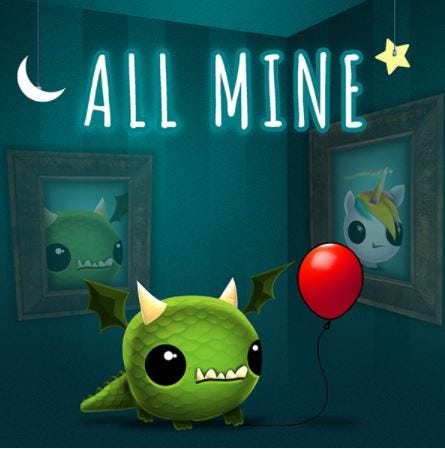
I personally have not developed an opinion on the “All Mine” game and concept. Until this game is widely played or gains awareness from the community, we won’t know what affect it may have on gaming or on blockchain. I will state that this game is not story related and these are typically design driven puzzle games. This should be ok for mining potential.
The issue I present for questionable narrative in videogames comes from a moment where we may go to far. What happens when mining through gaming is so popular, that triple A titles like Halo, for example, start having mining sequences in between storytelling.
Something along those lines can completely destroy the art and talent that created it and pull the gamer completely out of the narrative.
Would you stop in between a Martin Scorsese movie to mine crypto?
Cost Of Trade and In Game Items:
In every economy, digital or physical, there is always a secondary black market economy in action. The same applies for videogames and in-game items. “ More recently, Bloomberg published a report in which they explored how Counter-Strike skin betting essentially allows teens to gamble (which is illegal) and estimated that the secondary market moved $2.3 billion in 2015 alone. It is, to borrow a term from the seminal early ’90s Disney cartoon Bonkers, bonkers.”[3]
Why does this happen? In short the answer is fixed trading. Every videogame garners a community of people chatting about it. In almost every case of a major competitive videogame (with items or rank-ups) you will find players cheating the system. With trading, they do this by placing online team bets, where players can wager their items in competition. It becomes insider trading when the losing team only loses because of a private deal before the match. A rigged match means rigged profits.
This black market is only intensified by crypto, because in this game you aren’t only playing for items, but for crypto that can be traded for real cash. This could cause real world volatility!
That’s a serious problem for video cryptocurrency. Until a solution is met, this is the biggest issue for gaming companies investing into crypto tech.
Verdict: Gaming at this point does not need cryptocurrency as a means for in-game purchase. There are many boxes to check off before taking that route, specifically insider trading within videogames.
Possible Solution: In-game currency should be tokenized only for the purpose of insuring purchase validation on a blockchain. It can also be used to insure account verification and trust on large game markets. EX:Steam accounts purchasing or downloading.
[1]https://www.pcgamesn.com/fortnite/fortnite-vs-pubg-map-players-graphics-gameplay-weapons-review
[2]https://cryptobriefing.com/video-games-mining-cryptocurrency/
[3]https://steamed.kotaku.com/why-people-are-flipping-out-over-the-counter-strike-gam-1783369102
The post Video Games…and Cryptocurrency? An Analysis appeared first on CBNN NEWS.
]]>The post NewCurr SHOWCASE appeared first on CBNN NEWS.
]]>The post Cryptocurrency is not Fiat! So stop giving it the same economic models… appeared first on CBNN NEWS.
]]>Inflation VS. Deflation: The World Stage For Crypto Buyers
For those placing their hard earned cash into potential and risky investments across the new cryptocurrency exchange market, there is a wide birth of businesses that are creating networks with an even wider variety of token supply or infinite token supply. It can be exhausting and nearly impossible to sift through hundreds of potentially captivating and groundbreaking decentralized projects. Before engaging with the prospect of purchasing into a new crypto or crypto-related business, it is important to understand that a majority of these have crypto allocations that can have significant long term problems. These cryptocurrencies, and practically all digital currency DO NOT HAVE THE SAME ECONOMIC OR FINANCIAL MODELS OF FIAT CURRENCY. WE SHOULD ALSO ACKNOWLEDGE THAT THESE TOKENS ARE NOT NATIVE CURRENCY OF A NATION STATE, SO THEY ARE NOT NECESSARILY BACKED BY SUBSTANTIAL ENTITIES.
Typically speaking, businesses with an unlimited token supply are subject to multiple examples of inflation. One of the biggest issues with inflation, which is similar to issues with fiat currency, is that it can potentially devalue the existing supply. This in effect may devalue a current members’ economic status on the crypto market, or render them incapable of future purchases. This is a negative since the constant ability to buy and sell can lead to economic growth.
Inflation within an unlimited token cap also makes it difficult for a potential buyer to estimate the risks of a cryptocurrency investment. In cases where a token has an unlimited cap, fluctuations in price occur and tend to be violent compared to those with a limited supply.
While fiat currency and unlimited token supply share some of the same problems relating to inflation, there is reason to suggest that unlimited token supply is potentially more disruptive because of its distribution capabilities.
Fiat Currency can be duplicated as much as a Government may need. However, the rate of distributing this new supply is much slower than their unlimited token counterparts. Because fiat exists as paper in the open real life market, it could take months for the currency to exchange hands and filter through an economy, which can create stabilization.
In cryptocurrency settings, a new supply can be distributed to thousands of wallets instantly.
Slow inflation has some stability in the physical markets, but rapid inflation on the level of cryptocurrency is simply not sustainable if created by developers that care more about their technology than economic well-being on a global scale.
If a blockchian developer releases a new token or coin supply over a period of time, it could potentially have resemblance to fiat currency.
This is not something we should strive for, since day trading in cryptocurrency is valued against the fiat markets. Trying to emulate fiat currency will only infect cryptocurrency trading and the multiple exchanges it resides on.
The Nation State And Cryptocurrency Organizations
Inflation is just one economic model that CURRENTLY does not work for cryptocurrency markets. It is important to point out that this article does not factor in more complicated payments such as loans. We are not including this because cryptocurrency has not reached that level of complexity yet. When it does, the models for token supply may change.
The biggest concern for Decentralized Organizations and the unlimited token supply that exists come from Nation State laws.
The protocols that exist on a blockchain network, as well as how a “Miner” is compensated has strong similarity to a monetary policy.
Countries have their own monetary policy for their native fiat currency, and a majority don’t completely approve of borderless policy because it infringes on a countries particular economic interest or domestic markets. Beyond that, countries must meet their own type of consensus. If a country must meet their own structured financial consensus AND the consensus of a borderless currency, then there is a good chance of diplomatic confusion.
A good example is the Euro.
However, the opposing argument might be that a blockchain protocol could make amendments in accordance with a more unified borderless currency, something many nations could agree on for better economic flow.
It is important to understand that unlimited token/coin supply is very new technologically compared to fiat currency.
That is not to say that unlimited token supply and managed inflation is not viable, but at this early stage, limited token supply has less volatility in a market that is still learning.

Pallas Coin Distribution
NewCurr’s Reasoning On Its Own Network
We want to explain why we personally chose a limited coin supply, rather than an infinite supply.
Our blockchain, and its proof of information protocol, is being built on the basis that we handle the content of information as a primary objective, not as a product of a currency. Therefore, it is logical to limit the coins for this concept, because future members/node rewards are derived from their commitment to valid information and its applications on the network. We believe information, and its transparency, has a larger value within the ecosystem. This works effectively in our network because altruistic behaviors, whether made in good faith or for monetary gain, increases each coin and its value.
We also believe that our coin can work more efficiently in this system as an access token/membership value. This goes beyond the idea of cryptocurrency resembling fiat, because you’re not purchasing a Pallas Coin just for potentially gaining future value, but to access the membership of multiple decentralized applications in partnership with us. It can also be used as an access key for our future search engine. This engine manifests from the circulation of information that was created by our architects and members. AND all of this data must being transparent, accessible, and consent structured. Pallas Coin or Token is simply the facilitator for this process.
In short, a limited coin supply is the best measure at NewCurr because we’re utilizing cryptocurrency as a unit of accessibility, NOT as general currency. In the future, financial speculation from outside viewers may not just arrive from our limited coin supply and amount of traffic, but from the actual products and services we distribute that attain real world value.
The intention of this article is to invoke thought about the economic models currently in play within blockchain networks.
We do not rule out unlimited token supply as a future economic model. For now, in this stage of this new technology, limited token supply is a much safer buy because its value hinges on the products and services that are offered.
The NewCurr Team
Follow us on Twitter @NewCurr
The post Cryptocurrency is not Fiat! So stop giving it the same economic models… appeared first on CBNN NEWS.
]]>