deneme bonusu veren siteler - canlı bahis siteleri - casino siteleri casino siteleri deneme bonusu veren siteler canlı casino siteleri error code: 520
cbnn story – CBNN NEWS https://cbnn.io CRYPTO- BLOCKCHAIN NEWS NETWORK *MANAGED BY BLAKE BROADCASTING Sat, 21 Apr 2018 04:12:33 +0000 en-US hourly 1 https://wordpress.org/?v=6.2.9 https://cbnn.io/wp-content/uploads/2019/02/cbnnlogolargeweb2-300x300.jpg cbnn story – CBNN NEWS https://cbnn.io 32 32 Block Creation On Pallas-Athena (Basic Intro) https://cbnn.io/2018/04/13/block-creation-on-pallas-athena-basic-intro/ https://cbnn.io/2018/04/13/block-creation-on-pallas-athena-basic-intro/#respond Fri, 13 Apr 2018 03:54:49 +0000 http://cbnn.io/?p=2112 Block Creation On Pallas-Athena (Basic Intro) This piece will focus on how NewCurr is working to create a blockchain with our patent developing Proof of Information protocol. Our intent with Continue Reading

The post Block Creation On Pallas-Athena (Basic Intro) appeared first on CBNN NEWS.

]]>
Block Creation On Pallas-Athena (Basic Intro)

This piece will focus on how NewCurr is working to create a blockchain with our patent developing Proof of Information protocol. Our intent with this design is to create a network where block generation is more compatible with future search systems.
The internet was founded on structures that make the reading and understanding of data assets comprehensive and interactive for every User on a network. The ability to transform complex decentralized information into legible display is one of our top missions. Here is a brief intro on our work…
As a block is being created on the Proof of Information protocol, it will have a tag in the smart contract and Olympus Contract library (both referred in the whitepaper). The tag will allow the user to search for any block under the set parameters dictated by the type of tag. This will make the blockchain searchable for any known tags that are desired, while also ensuring the organization of the chain as a whole. As time goes on this will be applied on the macro level by putting broader labels onto the tags, thereby allowing for people to see the health of industries or any number of relative macro data points. These tags are broken down into the following.
Gene: A Gene is a single block instance and it is a part of our Macro level chain.
Chroma: A Chroma is a group of blocks that share a tag. They are subcategories of the Macro level chain.
Helix: A Helix is a collection of Chroma, where the tag shares a label. A label is a metadata of the tags.

Simplified representation of Macro Vs. Micro chain
For example, Microsoft and Apple are both tags, but they would share the same technology industry label. The helix is a larger subcategory of the Macro level chain, which can be used to show the viability of markets.
These parameters will allow for a completely organized chain with an introduction to a real-time search query system. This is a rudimentary diagram of how our software will assemble chromas and helixes from the Macrochain. All chromas and helixes will be individually searchable and comprised of their own Minichain. Minichains will develop after this process and they enrich search fields over the time that the Macrochain develops.
We will be implementing 2 variations of “Stamps” that will further introduce valuable concepts to this design.
“IIP Signature” (Information Intellectual Property Signature): addresses the tier level system that is created and implemented for the Pallas-Athena blockchain. By creating signatures for divisible information structures layered into a full block, the community can build upon immutable transactions, further validating that already existing block. This creates further trust and security in the community.
“OP Signature” (Olympus Contract Signature): addresses the Olympus Contract Library where members of our community can earn Pallas Coins for providing new variations of crypto transaction contracts. These variations include aspects of contracts relating to any NewCurr Limited Company affiliated entity or user generated content.
With Proof of Information, a user within the network can provide evidence for possession of data, as well as what that data contains. This provides noteworthy evidence for where that source of data originated and whether that data was properly created during that origination. This also has significance across multiple versions of rights; including patents, artistic ownership, Dapps ownership, or any claim that exists in a document that is circulated across the Pallas-Athena blockchain.
Any modification to a finalized document or asset on this blockchain is subject to an alert system, re-evaluation and verification process that is more restricted than the first submission. This ensures proper action and community well-being. On our Pallas-Athena blockchain, if the information asset has not been touched or modified, it will produce the same signature that is distributed across the larger Pallas-Athena system, then process it for addition to our search engine. More information on this process will be released and consistently updated.
For any questions or discussion on what we’re creating, please join our Telegram at t.me/NewCurr
For up to date news on our developments, follow us on Twitter at NewCurr
The NewCurr Team
BlockchainBusinessTechCryptocurrencyNews

The post Block Creation On Pallas-Athena (Basic Intro) appeared first on CBNN NEWS.

]]>
https://cbnn.io/2018/04/13/block-creation-on-pallas-athena-basic-intro/feed/ 0
Cryptocurrency is not Fiat! So stop giving it the same economic models… https://cbnn.io/2018/04/09/cryptocurrency-is-not-fiat-so-stop-giving-it-the-same-economic-models/ https://cbnn.io/2018/04/09/cryptocurrency-is-not-fiat-so-stop-giving-it-the-same-economic-models/#respond Mon, 09 Apr 2018 00:41:34 +0000 http://cbnn.io/?p=47 Cryptocurrency is not Fiat! So stop giving it the same economic models… Inflation VS. Deflation: The World Stage For Crypto Buyers For those placing their hard earned cash into potential and Continue Reading

The post Cryptocurrency is not Fiat! So stop giving it the same economic models… appeared first on CBNN NEWS.

]]>
Cryptocurrency is not Fiat! So stop giving it the same economic models…

Inflation VS. Deflation: The World Stage For Crypto Buyers

For those placing their hard earned cash into potential and risky investments across the new cryptocurrency exchange market, there is a wide birth of businesses that are creating networks with an even wider variety of token supply or infinite token supply. It can be exhausting and nearly impossible to sift through hundreds of potentially captivating and groundbreaking decentralized projects. Before engaging with the prospect of purchasing into a new crypto or crypto-related business, it is important to understand that a majority of these have crypto allocations that can have significant long term problems. These cryptocurrencies, and practically all digital currency DO NOT HAVE THE SAME ECONOMIC OR FINANCIAL MODELS OF FIAT CURRENCY. WE SHOULD ALSO ACKNOWLEDGE THAT THESE TOKENS ARE NOT NATIVE CURRENCY OF A NATION STATE, SO THEY ARE NOT NECESSARILY BACKED BY SUBSTANTIAL ENTITIES.

Typically speaking, businesses with an unlimited token supply are subject to multiple examples of inflation. One of the biggest issues with inflation, which is similar to issues with fiat currency, is that it can potentially devalue the existing supply. This in effect may devalue a current members’ economic status on the crypto market, or render them incapable of future purchases. This is a negative since the constant ability to buy and sell can lead to economic growth.

Inflation within an unlimited token cap also makes it difficult for a potential buyer to estimate the risks of a cryptocurrency investment. In cases where a token has an unlimited cap, fluctuations in price occur and tend to be violent compared to those with a limited supply.

While fiat currency and unlimited token supply share some of the same problems relating to inflation, there is reason to suggest that unlimited token supply is potentially more disruptive because of its distribution capabilities.

Fiat Currency can be duplicated as much as a Government may need. However, the rate of distributing this new supply is much slower than their unlimited token counterparts. Because fiat exists as paper in the open real life market, it could take months for the currency to exchange hands and filter through an economy, which can create stabilization.

In cryptocurrency settings, a new supply can be distributed to thousands of wallets instantly.

Slow inflation has some stability in the physical markets, but rapid inflation on the level of cryptocurrency is simply not sustainable if created by developers that care more about their technology than economic well-being on a global scale.

If a blockchian developer releases a new token or coin supply over a period of time, it could potentially have resemblance to fiat currency.

This is not something we should strive for, since day trading in cryptocurrency is valued against the fiat markets. Trying to emulate fiat currency will only infect cryptocurrency trading and the multiple exchanges it resides on.

The Nation State And Cryptocurrency Organizations

Inflation is just one economic model that CURRENTLY does not work for cryptocurrency markets. It is important to point out that this article does not factor in more complicated payments such as loans. We are not including this because cryptocurrency has not reached that level of complexity yet. When it does, the models for token supply may change. 

The biggest concern for Decentralized Organizations and the unlimited token supply that exists come from Nation State laws.

The protocols that exist on a blockchain network, as well as how a “Miner” is compensated has strong similarity to a monetary policy.

Countries have their own monetary policy for their native fiat currency, and a majority don’t completely approve of borderless policy because it infringes on a countries particular economic interest or domestic markets. Beyond that, countries must meet their own type of consensus. If a country must meet their own structured financial consensus AND the consensus of a borderless currency, then there is a good chance of diplomatic confusion.

A good example is the Euro.

However, the opposing argument might be that a blockchain protocol could make amendments in accordance with a more unified borderless currency, something many nations could agree on for better economic flow.

It is important to understand that unlimited token/coin supply is very new technologically compared to fiat currency.

That is not to say that unlimited token supply and managed inflation is not viable, but at this early stage, limited token supply has less volatility in a market that is still learning.

Pallas Coin Distribution

NewCurr’s Reasoning On Its Own Network

We want to explain why we personally chose a limited coin supply, rather than an infinite supply.

Our blockchain, and its proof of information protocol, is being built on the basis that we handle the content of information as a primary objective, not as a product of a currency. Therefore, it is logical to limit the coins for this concept, because future members/node rewards are derived from their commitment to valid information and its applications on the network. We believe information, and its transparency, has a larger value within the ecosystem. This works effectively in our network because altruistic behaviors, whether made in good faith or for monetary gain, increases each coin and its value.

We also believe that our coin can work more efficiently in this system as an access token/membership value. This goes beyond the idea of cryptocurrency resembling fiat, because you’re not purchasing a Pallas Coin just for potentially gaining future value, but to access the membership of multiple decentralized applications in partnership with us. It can also be used as an access key for our future search engine. This engine manifests from the circulation of information that was created by our architects and members. AND all of this data must being transparent, accessible, and consent structured. Pallas Coin or Token is simply the facilitator for this process.

In short, a limited coin supply is the best measure at NewCurr because we’re utilizing cryptocurrency as a unit of accessibility, NOT as general currency. In the future, financial speculation from outside viewers may not just arrive from our limited coin supply and amount of traffic, but from the actual products and services we distribute that attain real world value.

The intention of this article is to invoke thought about the economic models currently in play within blockchain networks.

We do not rule out unlimited token supply as a future economic model. For now, in this stage of this new technology, limited token supply is a much safer buy because its value hinges on the products and services that are offered.

The NewCurr Team

Follow us on Twitter @NewCurr

The post Cryptocurrency is not Fiat! So stop giving it the same economic models… appeared first on CBNN NEWS.

]]>
https://cbnn.io/2018/04/09/cryptocurrency-is-not-fiat-so-stop-giving-it-the-same-economic-models/feed/ 0
The Art World NEEDS Blockchain https://cbnn.io/2018/04/09/the-art-world-needs-blockchain/ https://cbnn.io/2018/04/09/the-art-world-needs-blockchain/#respond Mon, 09 Apr 2018 00:03:08 +0000 http://cbnn.io/?p=29 The Art World NEEDS Blockchain We have come to a point in history where the human engine of creativity is merging with accelerated distributed networking systems, such as those in Continue Reading

The post The Art World NEEDS Blockchain appeared first on CBNN NEWS.

]]>
The Art World NEEDS Blockchain

We have come to a point in history where the human engine of creativity is merging with accelerated distributed networking systems, such as those in blockchain technology. Much like the art movements in Dada and Fluxus, when the world began to make a change, humanities response came through artistic expression. First this expression was in the classical artistic sense, with paintings embracing and cultivating the deepest corners of the mind. Now we have digital art, where reflection breezes past deep expression and into infinite accessibility on the internet. The explosive growth of digital art and 2-way communication in digital media gave rise to typologies of “electronic art”. This is not to be confused with digital art. I want to emphasize that “Often interactive and participatory, electronic art incorporates electronic components in the production or display of a work.”[1]

I’d like to present the idea that blockchain technology should be considered as a sub-genre of electronic art as a medium. I believe blockchains with the ability to overlay electronic information with physical entities is just starting to be understood. Cryptocurrency (as its first application use case) has proven its validity as a form of electronic art. I believe blockchain has the capability of melding classical art with digital. Classical art, such as paintings, are enhanced with electronic augmentation, but remain in physical space without duplication. I assume we could call this type of concept Recognition Art.

There are many bright minds in the technological space that are currently working on purely digital means of this application for recognition art. Many of these talented individuals collectively convene over digital spaces such as Github to discuss and implement these variations of “Tokens”. One variation of a Token is known as the “ERC 721” standard. In this instance “ERC-721 is a free, open standard that describes how to build non-fungible or unique tokens on the Ethereum blockchain. While most tokens are fungible (every token is the same as every other token), ERC-721 tokens are all unique. Think of them like rare, one-of-a-kind collectables.”[2] If this token is exercised on a distributed network (which it is with Ethereum app CryptoKitties) then there is straightforward evidence for a blockchain being classified as electronic art. The ability for an electronic token, with individual properties, to reflect independent value over another digit entity to signify its “rareness”, will reshape the internet in its totality. The ERC-721 system eliminated digital reproducibility, which is relevent when we disseminate intellectual property in physical or digital spaces.

Walter Benjamin, a renown German Philosopher, touches upon critical concepts of reproducibility. This was years before any blockchain or cryptocurrency or token was a speck of thought, but his messages hold true within the test of time. In his book “The Work of Art in the Age of Its Technological Reproducibility” he touches upon art as always having factors of reproducibility, even before the written word evolved through the Gutenberg printing press. He also explains how technology has increased our evolutionary speed and our ability of reproduction. Within his writing, I was struck by a statement he made because of its relevancy to how blockchain is truly revolutionary. He states “In even the most perfect reproduction, one thing is lacking: the here and now of the work of art-its unique existence in a particular place. It is this unique existence-and nothing else-that bears the mark of the history to which the work has been subject. This history includes changes to the physical structure of the work over time, together with any changes in ownership. Traces of the former can be detected only by chemical or physical analyses (which cannot be performed on a reproduction), while changes of ownership are part of a tradition which can be traced only from the standpoint of the original in its present location.”[3] I believe many of his points about reproducibility still hold true today. However, there is potential for blockchain to attain perfect reproducibility of classical artwork, while also allowing the ability to produce recognition to the original and individual form. We can and must learn from scholars within digital media and art, like Benjamin, so we can augment properties of a distributed network. This thinking will allow for true innovation of distributed systems beyond the economic abilities of a borderless currency.

While our societies thirst for cyber discovery will propel us into a future we cannot yet predict, I personally hope it is a positive future. We must always take these discoveries and make them applicable to physical entities. Blockchain and its ability to perform recognition art as a subgenre of electronic art does just that.

I personally believe we could use tokens, such as the ERC 721 standard, as a store of value for the recognition of physical classical art. We can create a unique unit of value token on a blockchain that correlates to original art pieces circulating privately or at art exhibitions. Because the ERC 721 standard has an indexical relationship to “Rareness”, then the concept can be transferred onto a system where the unit of value correlates to a physical piece of art, as well as its value in the natural marketplace. “More than 50,000 pieces of artwork are stolen each year around the world, and the black market for stolen art is valued at between $6 billion and $8 billion annually.”[4] Theft is a problem that may never be fixed, since it is an issue beyond technology. There are ways to limit the amount of theft. Using a blockchain distributed ledger system, accommodated by a standard such as ERC 721, there is serious potential to attach Recognition through distributed systems to stolen art pieces. Individuals, museums or galleries that had art stolen from them will still have their token, which is a representation that the art cannot be reproduced and signifies its ownership. The token is very valuable, because in this scneario, a thief on the black market cannot sell the painting without the token. A token being deployed on a blockchain cannot be duplicated with limited supply. It would be nearly impossible for the thief to forge a false token or coin.

In such a situation, if a thief were to steal a physical art work, they would also have to infiltrate a person’s electronic wallet, which takes much more skill and is increasingly difficult. This is just one of many examples of how blockchain works as electronic art, or at least supports electronic art with recognition capabilities.

Jonah Blake

[1] Digital Art and its Relatives: Understanding the Typologies

[2] http://erc721.org/

[3] THE WORK OF ART: SECOND VERSION

[4] https://economiststalkart.org/2016/05/31/why-are-there-so-many-art-thefts-and-what-can-be-done-about-them/

The post The Art World NEEDS Blockchain appeared first on CBNN NEWS.

]]>
https://cbnn.io/2018/04/09/the-art-world-needs-blockchain/feed/ 0
Will BLOCKCHAINS GET BLOCKED IN EUROPE? GDPR and its potential affects On Decentralized Networks https://cbnn.io/2018/04/08/20/ https://cbnn.io/2018/04/08/20/#respond Sun, 08 Apr 2018 23:18:07 +0000 http://cbnn.io/?p=20 Will BLOCKCHAINS GET BLOCKED IN EUROPE? GDPR and its potential affects On Decentralized Networks In 2016, before the exponential bitcoin climb, the EU was working on GDPR the (General Data Continue Reading

The post Will BLOCKCHAINS GET BLOCKED IN EUROPE? GDPR and its potential affects On Decentralized Networks appeared first on CBNN NEWS.

]]>

Will BLOCKCHAINS GET BLOCKED IN EUROPE? GDPR and its potential affects On Decentralized Networks

In 2016, before the exponential bitcoin climb, the EU was working on GDPR the (General Data Protection Regulation). This regulation will be in effect for all EU member states on May 25, 2018.

While GDPR is a step in the right direction for Individual privacy and data rights, it is important for those building blockchain technology to understand what this regulation entails and how it may affect the overall protocol, data architecture and exactly how blocks may be constructed to fit those legal agreements. Before we delve into how it could affect those networks, let’s first look at some of the general rules that are written in GDPR. Please be aware that if you wish to discover all of the details and proper citations, as well as any documents pertaining to GDPR, visit an EU affiliated website or provider. We are in no way affiliated with or endorsing any legal documentation from any nation state. This is strictly an informational piece and meant to invoke ideas.

The general premise of GDPR is to protect its EU citizens from corporations or other entities that may withhold or improperly use data from individual citizens of those particular member states. The EU takes this VERY SERIOUSLY, so those that do not comply to their regulations will face a multitude of fines, as mentioned by GDPR. The EU believes this document will protect their citizens and their rights to their own personal data. The most interesting fact about GDPR comes from the fact it is being instituted by every member state, so the regulation are in fact uniform. The core principles of GDPR are as follows…

  • Select companies may need to appoint staff specifically for data protection and its oversight for GDPR compliance.
  • If a data breach does occur, there must be a notification system to its users or members.
  • If a data transfer is active, it must be handled safely and according to GDPR compliance.
  • When data is actively processed into a system, a User must be notified that there specific data is being absorbed.
  • If data is collected and then notified, the data collection must remain anonymous for individual rights.

This is a simplification of GDPR core principles and for more information please read the actual document.

It is important to understand that this regulation not only applies to all member states in the EU, but to any entity that is marketing or selling a product or service to those states. This is a significant point for those building blockchain technology, because open blockchains typically need nodes from citizens of nation states across the globe.
The GDPR of the EU should not be viewed as a document that goes against decentralized networks. In fact much of the document shares many of the core ideological views of blockchain networks. However, those that have created blockchain networks before this mandate, may face multiple issues after the document is enacted.

The problem for current active and popular blockchain technology happens to be in its current model for immutability. Immutability is a core feature of the blockchain, and must remain a core function, but it relies on blocks building off one another like an elongated tower. If either a citizen or entity in the EU (or their member states) informs a blockchain organization that they don’t want their data on a particular network, it will be difficult to remove that data from a blockchain, It will also be difficut to remove or delete data from the past log of blocks. This is because it erases immutability based specifically on current blockchain models. If this problem occurs, a blockchain could potentially implode on itself! As of now the only solutions is that current blockchains must also comply with GDPR. This may be a difficult task.

There is no reason to be dismayed yet, because many blockchains can perform forks and network updates which can discover new immutability models that do adhere to Nation State laws.

At NewCurr, we look at immutability as a trust vs. accuracy situation. While many current blockchains hold trust in its immutability structure, that does not necessarily mean the information created block by block is accurate…and they can’t fix this problem in a tower architecture without starting from scratch with a fork.

In our structure, we are working on the ability to update or remove blocks from the network using our proof of information protocol. We take individual data rights with the upmost importance, so users should be able to decide how they wish to go about their privacy. This is why we believe the structure should work more like a historical timeline. Which is something we’re heavily working on at NewCurr.

We welcome your thoughts and ideas about blockchain structures. We collectively work well as a positive think tank.

The NewCurr Team

Follow us on Twitter at NewCurr
The post Will BLOCKCHAINS GET BLOCKED IN EUROPE? GDPR and its potential affects On Decentralized Networks appeared first on CBNN NEWS.

]]>
https://cbnn.io/2018/04/08/20/feed/ 0
Can We Save Students With A Blockchain? A Series Approach https://cbnn.io/2018/04/08/hello-world/ https://cbnn.io/2018/04/08/hello-world/#respond Sun, 08 Apr 2018 21:10:15 +0000 http://cbnn.io/?p=1 Can We Save Students With A Blockchain? A Series Approach We’re very happy to announce our first rollout partnership with DebtMet, a company geared towards helping students pay off their Continue Reading

The post Can We Save Students With A Blockchain? A Series Approach appeared first on CBNN NEWS.

]]>

Can We Save Students With A Blockchain? A Series Approach

We’re very happy to announce our first rollout partnership with DebtMet, a company geared towards helping students pay off their student debt. When we engage with potential partners for our blockchain developments, the verification and approval process is important. When we are presented with any app partner, we immediately need to make what we call a “Series 1 determination”. This means does this app meet our standards for a good service, without a blockchain being considered. Here are some sample questions we ask ourselves from our series 1 process and which we will use as a basis for consideration in the future:

· Is this something that can scale? If yes, how?

· Is there a market need? excluding the trivial

· Is there a basis for an accessible UI? If yes, is this UI typical or experimental?

· Does this neglect significant demographics? If yes, does that harm the service?

· Is there an international need? or a domestic need? Does that create cause and effect?

· What kind of front end and back end code is needed? Is it attainable?

· Is there room for some form of community engagement?

· Marketing Vs. Product? If marketing outways product, then the business is not viable in the short run.

· Long term gains? Socially and fiscally.

AND MOST IMPORTANT

· Is this app economically and financially responsible?

These are just a few questions we ask when we do a first take on a new product, service, or partnership. When advising entrepreneur’s we suggest you ask yourselves the questions above when considering a startup,

ESPECIALLY BLOCKCHAIN BUSINESSES.

With with the DebtMet team, we decided they did pass this series one determination, but it didn’t end there. For us to proceed with a serious partnership, the business or organization in question must then pass “Series 2 determination”. Series 2 internally refers to blockchain implementation. We need to not only ask ourselves if an app is worth it, but if it even requires the need for a blockchain. Here are some sample questions we asked ourselves.

· Does this app need our particular or a blockchain at all? If yes, why?

· Will a blockchain accelerate this particular app’s functions? Which ones? does that make the app better?

· Is the app inherently decentralized? If not, then could it be?

· Would their customers need a blockchain?

· Is this app generating real data, meaning not trivial?

· Is the company creating this app transparent from a corporate standpoint?

· Can this app include architects, and add monetary benefit for our freelance workers?

· Does this add to the complexity of their application? does that complexity harm the product?

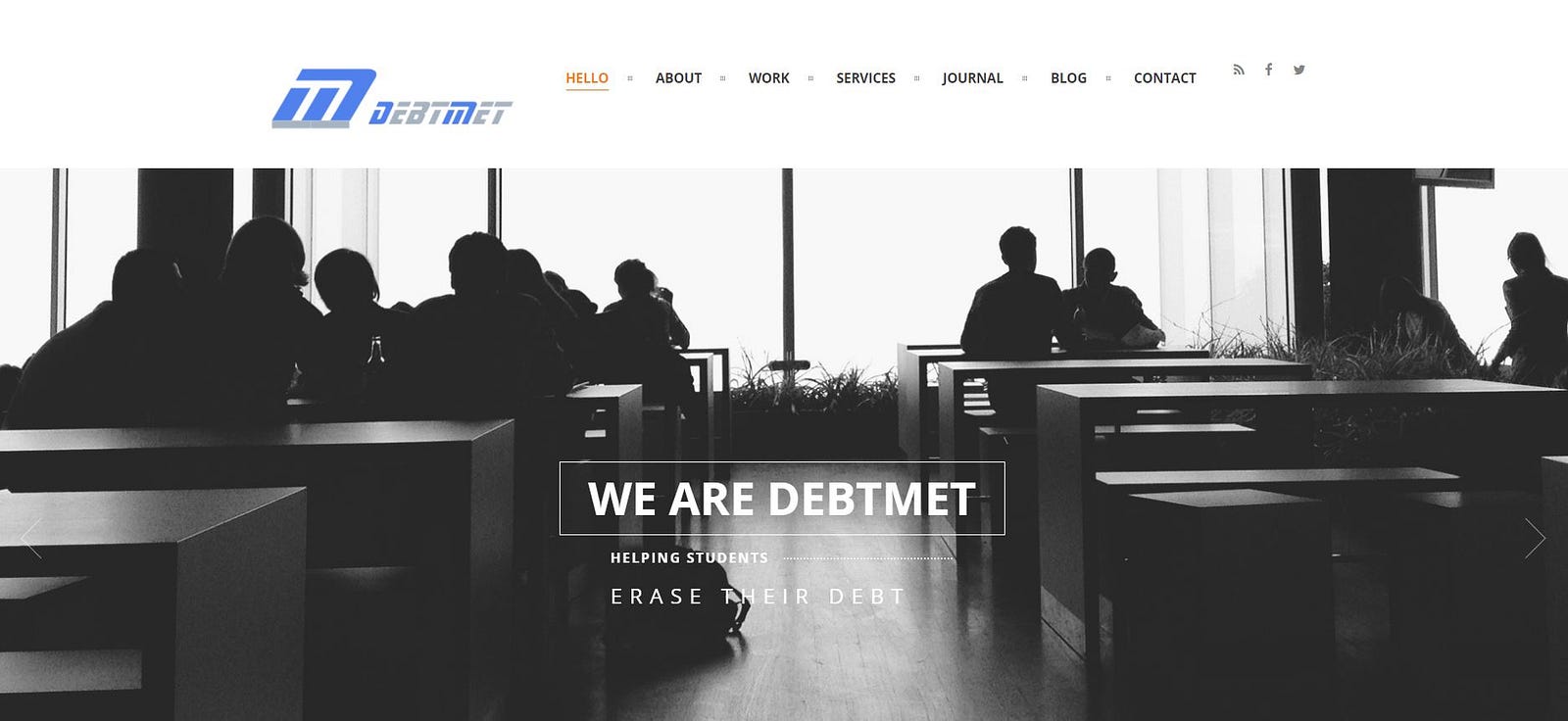
DebtMet.com

From DebtMet.com

Here is what DebtMet says about their service:

At the core of our service, DebtMet offers a one stop hub for anyone with debt. After signing onto our service and creating a personal profile (with the option for public anonymity with certain features), the user will have access to all of their student loans on one app. This will allow for easy management and instant payment to all loan lenders through one cohesive portal.

Our services are presented below:

The DebtMet “Social Finance Network”: This core baseline feature will allow users to create a personal profile, attached with images, personal biography, work history and a friends list. This baseline will be fundamental in aiding each user to alleviate or erase outstanding debt through means of network crowdfunding and direct messaging to friends, family, and businesses.

The DebtMet “Team leader Interface”: This allows companies within the user’s area to offer employment, while presenting competitive benefits that will help reduce the user’s debt burden. If the user accepts employment with the company offering these benefits, they will be given an update to their account that adds an employment tab. This employment tab will neatly organize user benefits, as well as create a clean portal for employee paid benefits and the company that has hired them. The Human Resources employer of these companies will be given access to a separate account on the DebtMet platform that will be specifically created for easier management of their employees as well as the benefits those employees receive.

This system will also streamline the transfer of those paid benefits to the employees direct DebtMet account. This program will give companies the opportunity to attract the best possible talent, create incentive for a more efficient workplace and reduce employment turnover rate.

While we will give our partners creative freedom that will help with their own specific employees, we have our own engineered programs that we can implement in any company that wishes to use them.

Listed below are some examples of programs that we have crafted:

1. Weekly Objective- company postings on the platform about certain goals or sales marks for the month, if achieved, that user will get an added percentage to their debt rebate from their employer. This improves work efficiency; HR team building and reduces the rate of employee turnover.

2. Employment Referral Program- If a current employee helps in the assistance of recruiting a new employee, and that new employee demonstrates a benefit to their employer, both the current and new employee will be given added percentage on their debt rebate from their employer. This improves recruitment and provides social network marketing at little cost to an employer.

3. Company Loyalty Program- If an employee stays with their employer for a minimum of 2–5 years and has a clean and efficient record that benefits their employer, the employer will increase their debt rebate percentage. This provides incentive to work efficiently, honestly and provide community for older existing employees.

4. College Intern Debt Benefits- Interns at top companies with a clean and efficient record will be given a stipend that will be used to help pay off their student debt. This will be added on top of the college credit they already receive from certain employers. This program will provide the best possible interns in competition at companies that are looking to recruit post-graduation.

The services provided by Debtmet (that are mentioned above) will neatly blend as a streamlined student portal, employment portal and Social Finance Network. Making crowd funding accessible to students in need and offering employment benefits platforms to companies in partnership will accelerate the amount of traffic and accounts we bring into DebtMet.

Adding to NewCurr’s Series Process, we internally felt DebtMet needed a blockchain for the following reasons.

1. A new generation of students will be active with the future of the internet.

2. Blockchain creates fair debt repayment distribution.

3. Transactions are verified, creating serious data on the debt industry.

4. We can introduce many Universities to the potential of blockchain related education.

5. Mainstream markets and established loan lenders can find positive benefits from this blockchain network.

Please see the NewCurr Whitepaper for more detailed information: http://newcurr.com/the-whitepaper/

For detailed additional info, please check out the websites at http://debtmet.com/ and http://NewCurr.com

Twitter: at NewCurr

Telegram: at t.me/NewCurr

The post Can We Save Students With A Blockchain? A Series Approach appeared first on CBNN NEWS.

]]>
https://cbnn.io/2018/04/08/hello-world/feed/ 0